RETROSPECT
by John Conway
July 29, 2016
AN INTERNATIONAL AIRPORT AIRLINES DON’T USE
It has been said before, and it bears repeating that virtually every significant historic or economic milestone in Sullivan County’s history has been sparked by a major breakthrough in transportation.
This phenomenon started back in 1764, when Daniel Skinner envisioned a way to utilize the Delaware River to transport timber to Philadelphia where it could be sold to the ship building industry, giving birth to the region’s first great industry. It continued through the construction of the Newburgh-Cochecton Turnpike, which enabled the population of Sullivan County to double in the first twenty years of its existence. The D&H Canal, completed in 1828, also spurred a population explosion, as well as the tanning and bluestone industries, and the arrival of the railroads in the second half of the 19th Century was the final piece in the county’s transition from an industrial economy to a tourism economy. The Liberty Highway in 1918 and the Quickway in 1958, each in its own way contributed to major changes in the county’s resort industry.
The construction of Sullivan County International Airport in 1969 was envisioned as another major breakthrough in transportation that would foster a significant economic milestone, the rebirth of the county’s floundering resort industry.
It didn’t quite work out that way.
There certainly was a sense of optimism and enthusiasm when the new airport opened in July of 1969, its 6,500 foot runway designed to handle twin-engine jets as large as the 105-passenger Douglas DC-9 and the three engine Boeing 727.
“Everybody who owns a piece of real estate is hanging on to it and anywhere in the county prices have grown six times in value,” Steve Stetka, Chairman of the Sullivan County Board of Supervisors told the New York Times.
”What the completion of the $6.5 million project, whose finishing and not-so-finishing touches are still to be applied, has created here is a general feeling of optimism that a surge of economic development will occur in the next few years,” Times reporter Leonard Sloane wrote in a July 28 article that year. “To this well-known 1,500 square mile resort area north of New York City, such development will be welcome.
“Not only will it bring additional business visitors and vacationers to the Catskill region, local enthusiasts believe, but it will also serve as a spur to existing businesses and a magnet for the light industry and research plants that are being sought.”
Of course, much of the impetus for the construction of the airport came from the local resorts, a $60 million annual industry that was struggling, and for whom it was envisioned as a much needed savior.
“Speak to members of the Catskills Resort Association– who handled 4,500 groups among their 2 million visitors in 1968 and expect substantially more in the years ahead—and you find an overall anticipation that their market, both for convention and individual sales, is about to expand dramatically,” the Times reported shortly after the airport officially opened. “‘The Catskills have always drawn upon New York as its prime source of revenue,’ says Howard L. Bern, director of sales at Grossinger’s. ‘Now, as transportation to get here becomes easier, the perimeter of business becomes larger.’
“Gordon Winarick, executive director of the Concord, points out that ‘the airport, a status symbol, has jelled us into the concept of thinking as an area. It’s not going to happen automatically but it will become a very vital link for us.’”
And the hotels were also viewed as a vital link in the success of the airport. Grossinger’s and Kutsher’s collaborated on a plan to encourage vacationers to fly in on charter flights from cities such as Pittsburgh, Detroit, Baltimore and Washington. The Concord organized a plan with 14 other hotels, some of them not in Sullivan County, to offer an all-inclusive Sunday to Sunday tour package to people in Chicago and the Midwest for $239. The plan was for tourists to spend the first four nights at a Sullivan County resort, one night in a motel in Catskill, in Greene County, and Friday and Saturday nights at the Waldorf-Astoria Hotel in New York City, travelling between the points on a sightseeing bus.
“There is no doubt that all the major hotels in our area eventually will be involved in encouraging charter flights to the new airport,” Grossinger’s General Manager Morton Sunshine told the Times. “The airport is sure to help us all, and we are determined to help the airport. Indeed, we are even encouraging our personnel to use Mohawk’s regularly scheduled flights whenever they have occasion to travel.”
Mohawk Airlines was the first scheduled carrier to use the new facility, and provided the “International” for the airport’s official title by way of its scheduled flights from Montreal and to Toronto. Daily flights also departed for Buffalo, Elmira and New York, connecting travelers to Boston, Cleveland, Detroit, Pittsburgh and Washington.
Despite the optimism that accompanied the airport’s opening, however, it never fulfilled expectations, or even came close. Plagued by problems from the outset, including a long, brutal winter and labor problems that delayed construction and pushed its completion date from spring to mid-summer, the facility went through five operators in its first four years of operation, and by 1972 was under investigation by the U.S. Attorney’s office for alleged fraud during its construction.
In 1985, the Times ran a story about the nearly deserted operation under the headline, “In the Catskills, An international Airport Airlines Don’t Use.”
More on that next week.
John Conway is the Sullivan County Historian. He can be contacted by e-mail at jconway52@hotmail.com.
RETROSPECT
by John Conway
August 5, 2016
THE CAVALCADE OF JETS NEVER ARRIVED
When Sullivan County officials announced in December of 1966 that they had received a Federal grant for the construction of an airport large enough to accommodate commercial jet planes, they envisioned bringing new resort business and eventually new industry into the county.
When the Sullivan County International Airport finally opened in July of 1969, county officials and local businessmen predicted it would “open new vistas” for the county. Sullivan County National Bank chairman Joseph Fersh was among several quoted in the New York Times’ July 28, 1969 edition.
“We will attract more affluent people to the area than we now have,” he said. “And this has to have a terrific impact on the entire economy.”
Lumber yard owner and home builder Manny Bogner of Monticello was even more effusive. “We have already found that a lot of people whose occupation is not a fixed-base occupation, like sales people or entertainment people, have been increasingly ready to move up here because they’re now in touch with the whole Northeast,” he told the Times.
And insurance executive Max Rhulen added, “It’s quite conceivable that we’ll develop some sort of aviation industry in the area. After all, we have the longest runway between New York and Buffalo.”
Within a few years, however, the airport had gone through five fixed base operators and the United States Attorney’s office was investigating reports that the Federal Government had been defrauded in the construction of the facility.
“According to local sources close to this quiet investigation, witnesses have testified that runway soil samples were falsified to conceal findings that the soil in places would not support the proposed runways,” the Times reported on July 15, 1973. “Some county officials and businessmen were also reported under suspicion for allegedly improperly benefiting from construction work at the airport.”
The leak to the media that the federal investigation was underway prompted one county official to ask the Sullivan County District Attorney to impanel a special grand jury to investigate “all phases of design, construction and operation” of the airport.
John J.J. McGough, the county’s Commissioner of Public Works and chairman of the County Airport Commission, wrote to District Attorney Louis Scheinman that he was “personally unaware of any impropriety or wrongdoings by anyone involved in or connected to the airport” and promised his full cooperation if Scheinman agreed to the request. McGough noted that articles in the New York Times and Middletown Times Herald-Record newspapers had raised a cloud of suspicion in the minds of the public with allegations and innuendoes about the project and a grand jury would be the only way to remove the suspicions.
Scheinman denied the request about a week later, saying he had never seen any evidence of any impropriety and no one had ever come forward to present charges.
“If there were any evidence of wrongdoing, the investigation would be underway,” Scheinman said. “But the grand jury has more to do than answer letters and conduct investigations to clear one man’s name.”
Even as the federal investigation was underway, another controversy had enveloped the airport. Absent an operator and a carrier to serve it on a regular basis, county officials drew up a contract with Hudson Valley Airways, which was newly owned and operated by Robert H. Abplanalp, owner of the Eldred Preserve resort and a close friend of President Richard Nixon.
The contract, the Times reported, “would be for up to 38 years under terms generally considered even by the county officials who agreed to them unusually favorable to the multimillionaire.”
The contract, according to the Times, would have required Abplanalp to pay the county just $55,000 a year through 1981 and then slightly more than that through 2011. In return, the county would commit to “maintaining the grounds and runways, expanding certain facilities and building access roads to any facility Mr. Abplanalp constructs” while exempting him from sales tax “or any other charges, fees, or tolls of any nature” in airport transactions.
Many locals hollered “giveaway” and asked that the contract not be signed.
Milton Levine, chairman of the county’s Board of Supervisors, admitted that the deal was more than just a bit one sided, and yet acknowledged the county had little choice.
“It’s a bad contract- let me be honest with you,” Levine told the Times. “But I am interested in seeing this airport operate on any terms. I wouldn’t care if there is no contract.”
Leon Greenberg, president of Monticello Raceway and the Catskill Resort Association, as well as the secretary of the Airport Commission, added that “air service is vitally needed and beggars can’t be choosers.”
Nonetheless, after months of controversy, Abplanalp, citing lack of public support for his taking over the airport, declined to sign the contract, leaving county officials back at square one.
Though the federal investigation eventually fizzled out, the airport’s fate never improved. In fact, in September of 1985, the New York Times was prompted to run an article about the facility under the headline “In Catskills, An International Airport Airlines Don’t Use.”
“With great pomp and ceremony, an international airport opened 16 years ago in this tiny rural community in the Catskills, 100 miles from New York City,” the article began. “The Sullivan County International Airport was paid for with $4 million from the Federal Government and $2 million from the county. Local officials anticipated cavalcades of jets unloading swarms of tourists ready to play the casinos that long have been discussed as a way of rejuvenating the area’s depressed economy.
“But the slot machines never came and the jets never arrived.”
John Conway is the Sullivan County Historian. E-mail him at jconway52@hotmail.com.
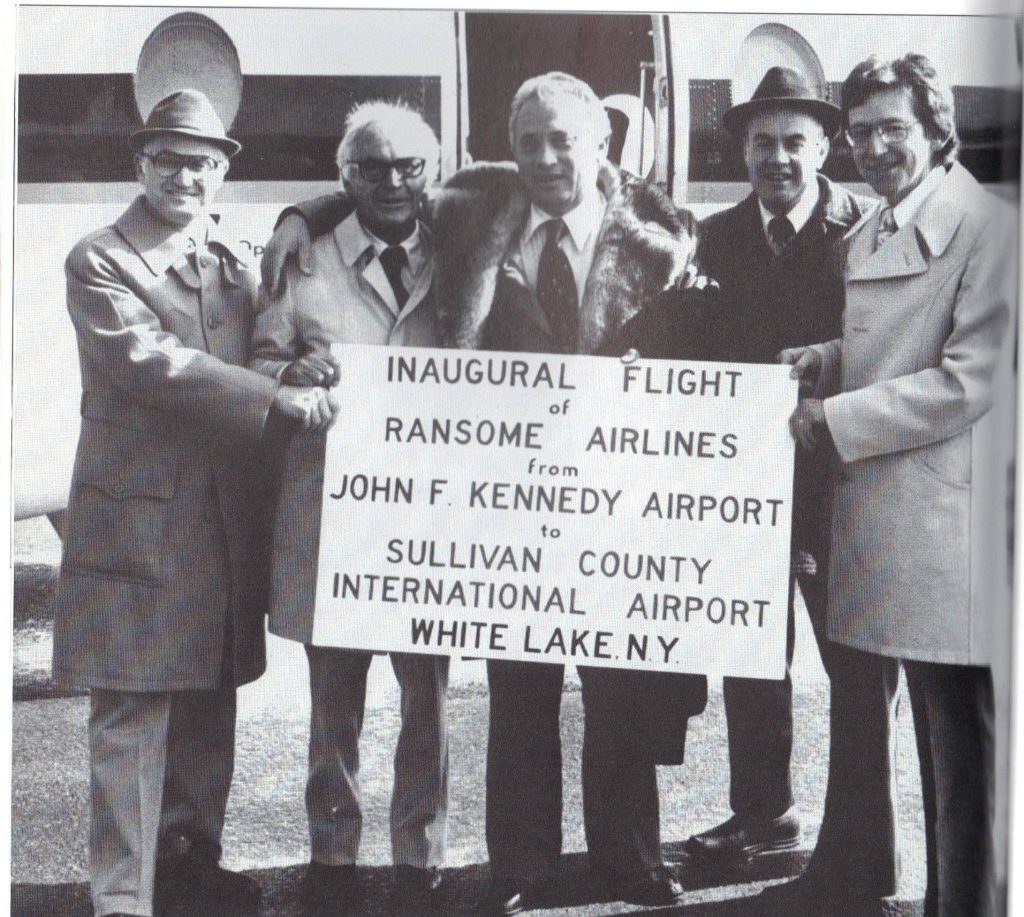
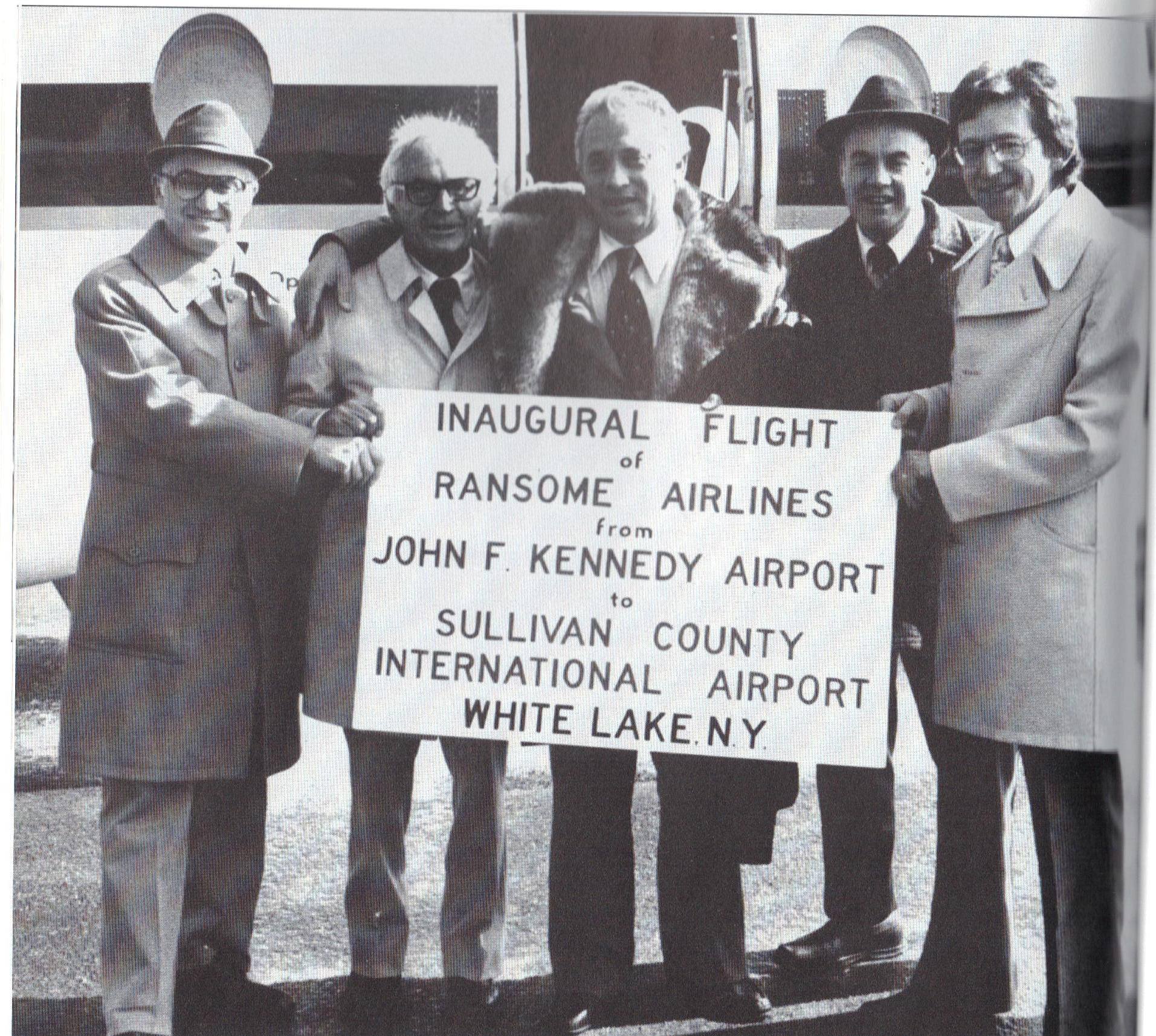
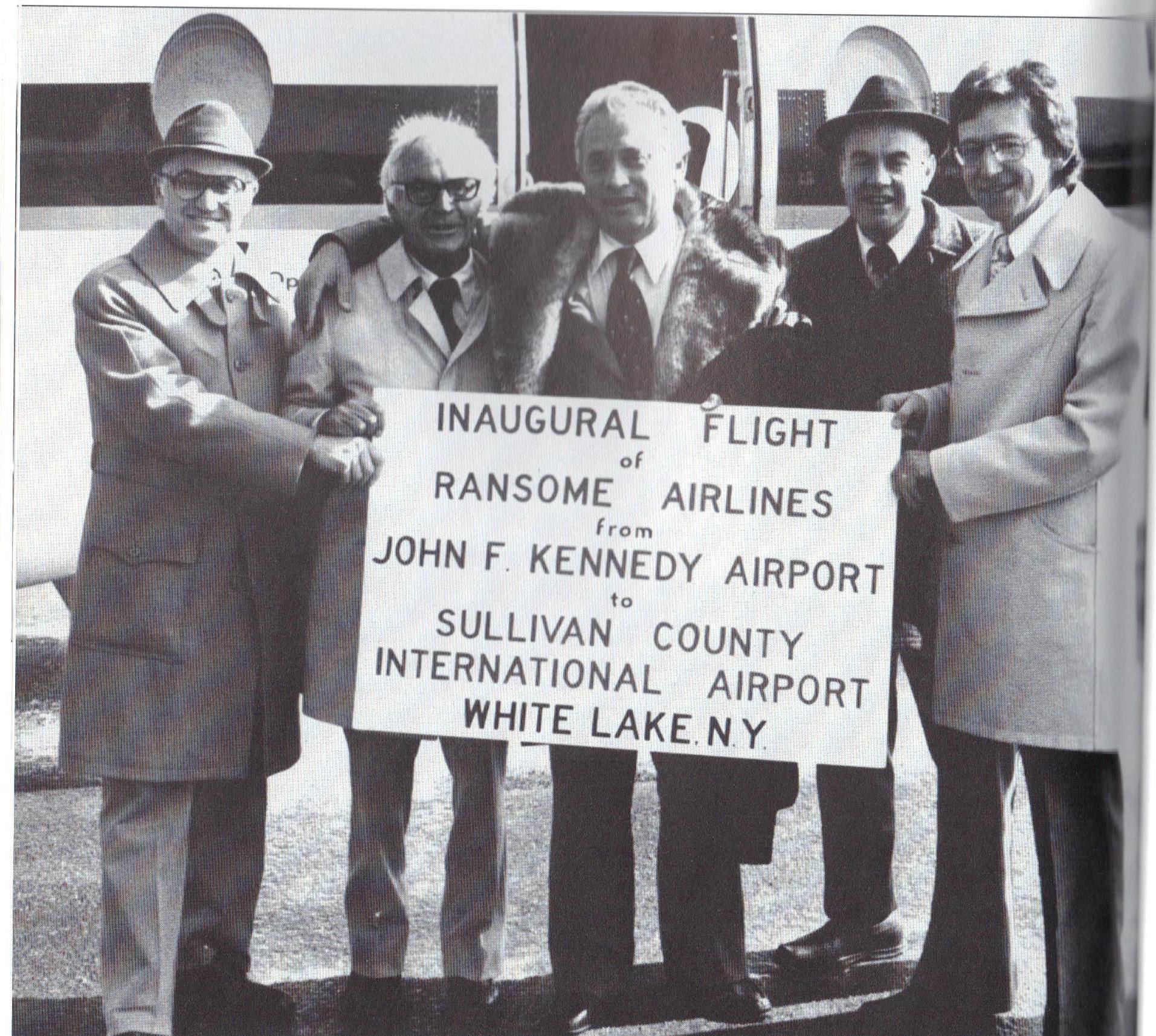
PHOTO CAPTION: Sullivan County officials, including (left to right) Board of Supervisors chairman David Kaufman, Airport Commissioner John J.J. McGough, Airport Commission Secretary Leon Greenberg, Bethel supervisor Russel Gettel, and county administrator Paul A.Rouis, mark the inaugural flight of Ransome Airlines in the late 1970s. Ransome was one of several airlines to try unsuccessfully to provide regular air service to the Sullivan County International Airport.