Heading back home to NYC in the morning. Left home on February 17th, 18 days ago. I miss my bed.
It’s Leap Day and I’m in Sofia, Bulgaria. I’m about to finish a two week deployment. It’s been 4 years since my last deployment here ended in the pandemic. I can hear the sound of planes flying over the hotel.
Testing syndication from my website to Bluesky. Have been meaning to do this for a while.
In my previous post, Finding The Right Outdoor Air Quality Monitor, I laid out my decision making process for purchasing the AirGradient Open Air outdoor air quality monitor kit.
Posted pictures of my new air quality sensor construction over at the tech site I contribute to. Excitedly hoping it doesn’t fail like the previous one.
One of the biggest mistakes of critics of Israel’s war against Hamas in Gaza is attempting to compare the war to a past modern war (post WWII) or battle that is not what Israel is conducting in Gaza. 🧵 pic.twitter.com/StGeCgcLra
This is probably the best analysis of why the situation in Gaza is often misconstrued by the international community that I’ve seen. I’ve tried to repost it below, with appropriate attribution, as it was sent out as a series of X/Twitter posts.
The Author is John Spencer, who according to his bio is an expert on Urban Warfare and the Chair of Urban Warfare Studies at the Modern Warfare Institute at West Point. Sounds like a man with the credentials to speak with authority on the subject.
One of the biggest mistakes of critics of Israel’s war against Hamas in Gaza is attempting to compare the war to a past modern war (post WWII) or battle that is not what Israel is conducting in Gaza.
Israel is not conducting a counterinsurgency, counter-terror campaign (it may later) in a semi-permissive environment with host nation support, or fighting a single battle against a small terror force that has temporarily seized an urban area.
Initially I too tried to explain that the closest comparison of Israel’s initial attack of Gaza City was the 2016-2017 Battle of Mosul. As in a city attack of an enemy held city where the defenders were using human shields & had prepared a complex defense. But, even Mosul fails on multiple levels to compare in context to Israel’s war against Hamas in Gaza. None of the battles of Raqqa, Aleppo, Marawi, Mosul, or Fallujah are comparable to Israel’s operations for many reasons.
Again, Israel is not trying to find a few terrorists embedded in an urban environment where they have host-nation support and 90% of the civilians are not combatants or are not present such as 2004 Fallujah with 3,000 enemy fighters in a single city or the 2016-2017 Mosul with 5,000 ISIS fighters in a single city.
The IDF is fighting a full-scale war against a terrorist military of over 30,000 fighters with a massive arsenal of rockets, who has spent decades & millions of dollars digging an underground world of hundreds of miles of tunnels woven into the civilian society & with the design to reverse engineer the current laws of war (lawfare) to achieve their strategic goals.
Unlike other battles, the Hamas strategic goals are not to hold terrain or defeat Israel’s military but to sacrifice their civilians (so not human shields, but human sacrifices) to cause the international community to force Israel to stop their counter-attack.
No modern military has faced 13,000 plus rockets being launched over their heads at their homes while conducting their war/battle/operation.
Nor since World War II has a military fought in a situation where hundreds (now 136) of their own citizens (to include babies, women, elderly) are being illegally held hostage inside the combat area and a strategic factor in their timeline of the war.
Israel is not fighting in one city. It is fighting in five major cities. It is fighting a real and definable existential threat to the survival of their citizens and nation.
IMO, the fact is that Israel has followed the laws of war, has implemented civilian harm mitigation steps that no military has implemented in modern urban battles and people still attempt a moral equivalence with out of context battles.
Looks like I’ll be ringing in 2024 with my Lyft driver.
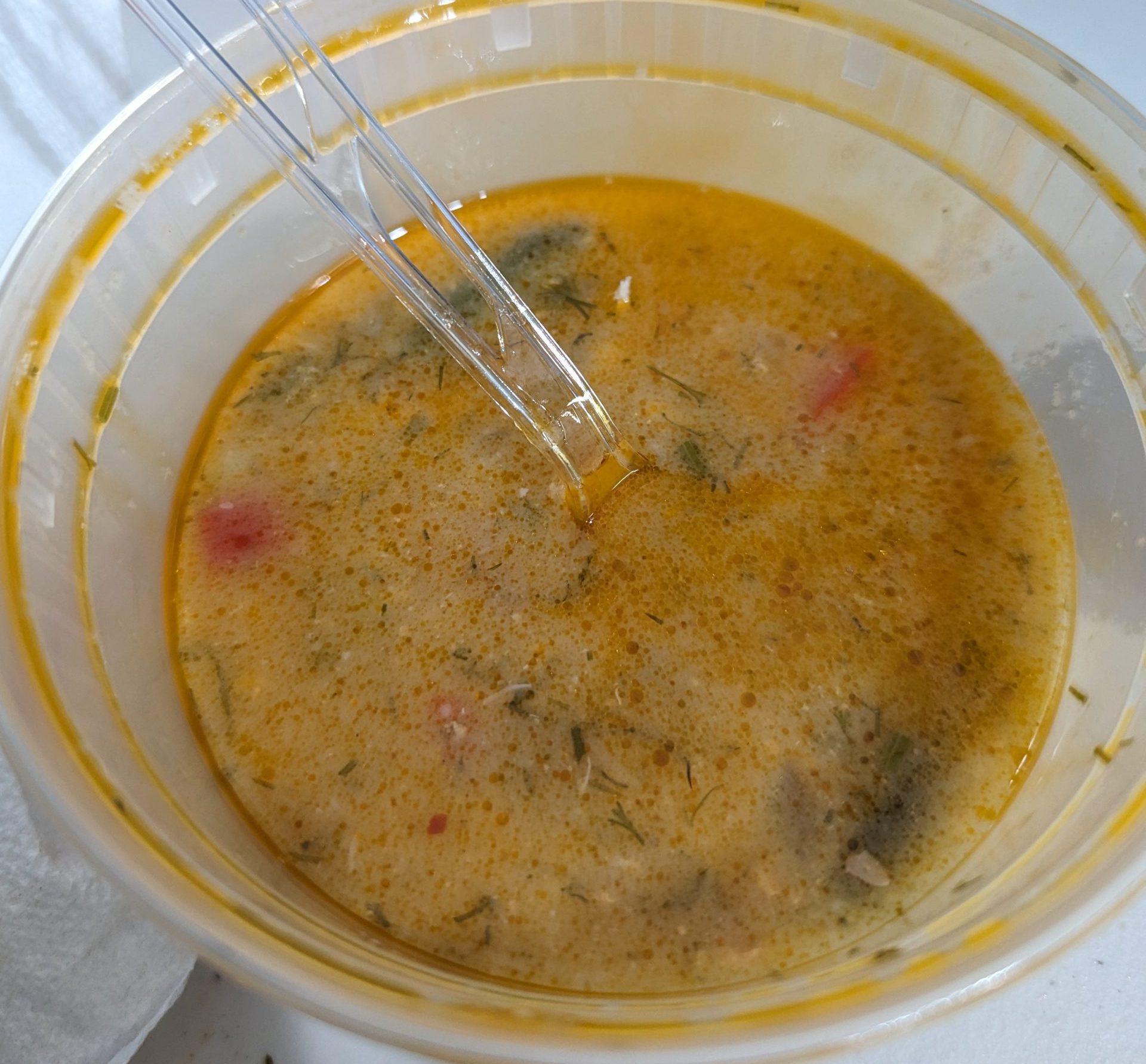
Soup Du Jour Salmon Chowder with corn, red peppers, and fresh salmon
⭐⭐⭐⭐⭐
This is my go to fish place in Florida, and my favorite salmon chowder location. Good taste, not too spicy…good fresh or reheated the next day.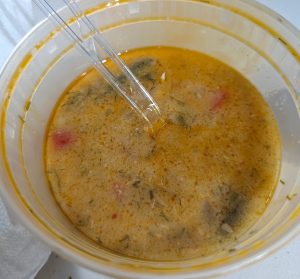
So I Finally Got COVID
The title sort of says it all. Three years of changing my behavior, getting criticized for still wearing a mask(which I’m not sure is anyone’s business any more than if I wore a bowler hat), my number finally came up.
It was a surprise to many people, including me. And to be honest, despite keeping up on things, I’m not an expert. I keep asking myself what chain of events led to this, but I’ll likely never figure out.
The incubation period of COVID is such that during the period I could have gotten it I was on a plane(and no one sat in the seat next to me), a train(also no one next to me), and walking around outside. Could I have been too close to someone when I took an outdoor mask break? Maybe. Who knows?
As of now, people who were close to me when I subsequently calculated I was probably contagious have not reported getting ill themselves. That was also hard for me to determine. I’ve had every COVID booster, which is supposed to reduce symptoms. And the symptoms felt like a sinus infection…which I get multiple times a year. I sniffle all year round, and there were several people where I was reporting sinus issues because of pollen that was flying around, so I made an assumption.
So, this gets to the…what do I learn from this? I’m still not sure. I don’t know how often I should test when I feel no symptoms. I didn’t go to anything when pre-testing was common etiquette. It clearly isn’t now for most people. So, I have come up with a few possible asymptomatic testing ideas and am trying to decide which to adopt.
- Test after any plane flight or similar as a confined space with close contact.
- Test before and after any gathering. Gathering being in close contact with a group of people for an extended period. Before to ensure not spreading anything unknowingly.
- Test after being in an outdoor space with other people for an extended period of time.
- Assume any respiratory illness or distress could be COVID and test.
So, I have been in isolation for 5 days as of tomorrow. The CDC has a page of advice on this. If you had symptoms, Day 0 is the day of symptom onset, regardless of your first test. Day 1 is the first full day after the symptoms start.
They advise staying at home for 5 days and isolating from others. You can end isolation after 5 days if you have no symptoms or if you have been fever free for 24 hours after Day 5.
Regardless of when you end isolation, you are supposed to, until Day 11, avoid being around high risk individuals and wear a mask. I got stuck in my parent’s guest room, and they are high risk individuals, so we’ll see what I figure out. They note that with two sequential negative tests 48 hours apart, you may remove your mask sooner than day 10.
There is also the risk of COVID Rebound. COVID rebound is defined as a recurrence of COVID symptoms and/or receiving a positive COVID test after having the disease and then testing negative. It has been reported to occur between two and eight days after initial recovery.
Of course, all of this is the advice of the US CDC. I checked the UK’s NIH website, and they don’t say anything about masks. The Canadian authorities state you should stay home until you experience no symptoms, and then wear a mask for 10 days. No wonder I’m confused.
I’m also trying to figure out the issue of cleaning…again for the benefit of high risk individuals. I have laundry piling up, and this building has a shared laundry room. So, how long before I put any laundry in? Do I disinfect the machine after? How? What do I do with things and surfaces I touched? The information on how long the virus might stay on a surface is somewhat varied. However, the general agreement is that the chance of catching COVID through surface contact is slim. Still want to clean everything though.
As an analytical person, I want to refine my behavior as a result of this, but I’m not sure exactly how. What do others think?
Disney’s introduction of MagicBand technology was a massive change for the theme park. The overall system began development in 2008, with the idea of reducing friction in the park, and the over $1 billion dollar project to integrate technology at Disney parks culminated with a rollout a decade ago in 2013. I remember the first…
IndieAuth for WordPress 4.4.1 Released
The latest update to IndieAuth for WordPress was released, which includes:
- Email notifications for incoming tickets if using the experimental Ticket Endpoint
- Microformats parsing for client information discovery
- Misc. Fixes
Indiewebifying a WordPress Site – 2023 Edition
Last year, I wrote a post on how to Indiewebify a site…it was actually in response to a CSS-Tricks post, and a successor to previous posts I had written on the subject. I’d suggest you read that article first, and return here, and I’ll go over where we are a year later, and what is to come.
We could always use more contributors to IndieWeb plugins, and there is so much to do. One of the biggest problems is probably that many community members, but not all, prefer classic WordPress to the current Gutenberg block editor, and this does hinder individuals who want to use the latest and greatest. For me, I just am not as interested in writing Javascript vs PHP code.
So, to summarize some things from last year, what has changed, and what is in the future.
The IndieWeb plugin offers an h-card template and widget. This would be the perfect place to add a block option if a contributor was interest. It adds tools to help you show your identity, and suggests other IndieWeb plugins you might try. Sort of a Jetpackesque idea.
It offers rel-me links, either visible or hidden. Now, other sites are using rel-me again…Mastodon, Pixelfed, etc. This allows them to also verify distributed identity…that one URL and another URL are the same person because they link to each other with links marked up with rel=”me”.
IndieAuth doesn’t have many new features to add, but it continues to be refined and improved for improvements under the hood. It allows you to log into a WordPress site using an IndieAuth endpoint…most commonly another IndieAuth enabled WordPress site, or for a client application to get a token to act on your behalf…most commonly a Micropub client.
Micropub, which is a plugin I intend to do some work on in the near future, allows you to publish content to your site using a Micropub client. The advantage of this is the Micropub server(built into the plugin), converts the Micropub vocabulary into a WordPress post. So there can and are a variety of bespoke applications that allow you to post any number of content types.
Webmentions, completing a long project, hit version 5.0 in April. The 5.X branch is a merging of the Semantic Linkbacks plugin and the Webmentions plugin, with a completely rewritten and updated codebase. The way webmentions were implemented prior to 5.0 was a direct copy of pingbacks and trackbacks. We have and continue to move away from that.
The IndieWeb is built on parsing of Microformats. Microformats are a specific and simple markup to HTML that allows a parser to gain context…and therefore render a reply, like, link preview, etc. The new Webmentions plugin has several fallbacks of less fidelity now, still favoring Microformats. If it is a WordPress site, it will try to render the information from the WordPress REST API. If it isn’t, it will try to get basic information from JSON-LD or meta-tags…This basic information is a summary, author(image and URL), etc.
Brid.gy, the service that bridges other sites to yours via Webmention and Micropub, has added some Bluesky support. Brid.gy Fed had come on to allow your site to interact with ActivityPub supported sites(like Mastodon).
WordPress has its own ActivityPub plugin, created and maintained primarily by the creator of many IndieWeb plugins, Matthias Pfefferle. I’m not personally involved in that as a contributor(he has more than enough interest elsewhere), but I’m a user of it.
Syndication Links displays links to other versions of a post..on any arbitrary site. It supports integrations with Bridgy and others to trigger the syndication to that other site.
A few other useful plugins….
- Simple Location – if you want to add location awareness to posts, and static maps, this supports it and integrates well with other IndieWeb plugins, because I wrote it.
- Tempus Fugit – A collection of time based website tweaks, such as adding This Day and This Week URLs and features.
If you do want to experiment with Blocks and the IndieWeb, you can try Jan Boddez’s Indieblocks.
If you prefer the Classic Editor, I still maintain the Post Kinds plugin for myself and others.
First LL 9am for Indiana Jones Adventure. Recent remodel.
IndieAuth for WordPress 4.4.0 Released
Version 4.4.0 of the WordPress IndieAuth plugin was released today, and it contains a lot of changes, but very little in terms of noticeable ones.
The biggest changes involve the removal of the already hidden by default Remote IndieAuth code, which allowed you to use a third-party indieauth endpoint. The plugin now only allows you to use the local code.
Why is this? Because the plugin is a full IndieAuth endpoint. If someone truly is interested in using someone else’s endpoint, then I’ve put that code aside if it is needed.
I also reworked a lot of the code based on the newest revision of the IndieAuth specification. I jumped on the revision bandwagon early for the plugin, but I had essentially bolted the new pieces onto the older code. I tried to move things around to integrate it more.
I had missed updating the Web Sign In feature to support the latest revision. Web Sign In is effectively an IndieAuth client. It allows you to log into your WordPress site using IndieAuth instead of a username and password.
So, you put in a URL, authenticate to that URL, and it will log you into your site. This is what indielogin does, although if there is no IndieAuth endpoint, it falls back on other things and the WordPress version does not..although it could in theory…just not sure what services it would fall back to.
This feature allows things like logging into a multi-user WordPress site with your personal WordPress site by linking the two and being logged in or logging into the personal site.
But this isn’t the end of it, because I have more ideas I’d like to play with for the future.
- Improve the process for how the system decides that a user is in fact, the same as the logged in user on the other site, possibly by having a list of approved domains that can authenticate?
- What if Web Sign In could be made the default for logging in?
- What if the act of trying to log into a WordPress site with your own website created a subscriber level user(a user with no privileges)? That user could then be issued permissions to view non-public information.
- More with Ticketing…which means more enhancements to allow a logged in user to see specific ‘private’ posts inside and outside of feeds.
Schumer Discusses the Double Standard
The world continues to be a scarier place. This week, Senator Chuck Schumer gave a speech on the floor of the Senate, trying to explain how American Jews, in general, feel about the situation. Schumer is the highest ranking Jewish official in the United States, in fact, the highest ranking Jewish official ever.
In my opinion, his speech and Biden’s speech of support for the victims on October 7th were some of the more powerful pieces of political oratory in recent memory.
Schumer covered the points that I keep trying to express myself, noting that Jews “are worried—quite naturally, given the twists and turns of history—about where these actions and sentiments could eventually lead.”
Earlier this week, at a high school not far from where I live, students tried to get a teacher fired who merely attended the March for Israel in Washington. To agree with the Senator…walking out of school in support of Palestinians is legitimate, even protesting within the school, but making this teacher a target is not. The teacher wasn’t teaching their personal views, and ended up hiding and fearing for their safety.
There is no moral justification for what Hamas did on October 7th. But too many people believe otherwise.
Three individuals in Brooklyn this past Saturday approached Jews going about their business, and unprovoked, punched or kicked them, and apparently yelled, “Free Palestine.”
The IHRA has a working and nuanced definition of anti-semitism that is definitely worth reading. While I may be able to say that criticism of Israel in itself is not anti-semitism, many of those who are protesting demonstrate that they aren’t just criticizing Israel.